
Join us as we celebrate the 40th anniversary of The Legend of Zelda. Discover its rich history, cultural impact, iconic games, and what the future holds.
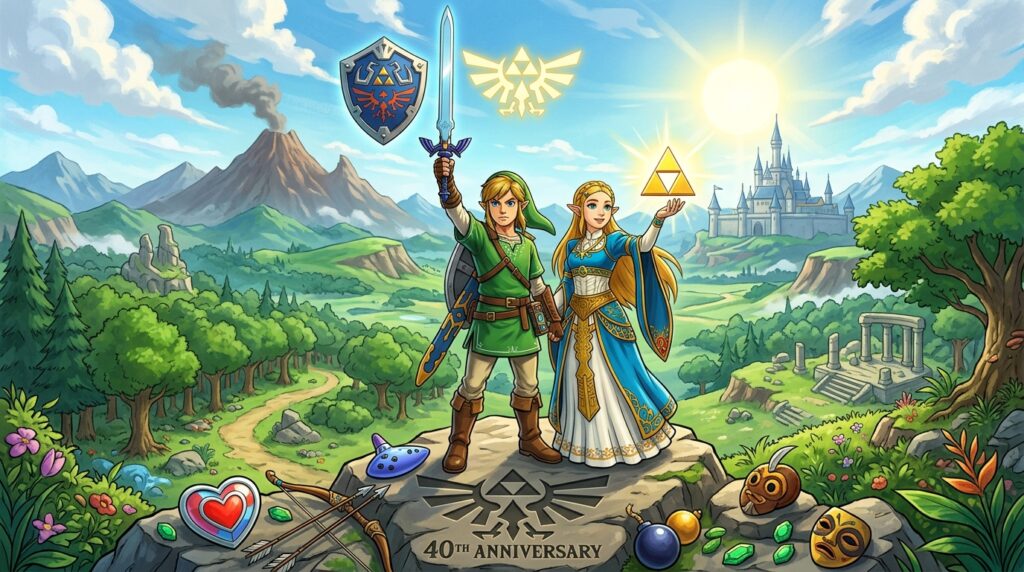
Forty years ago, a young boy in a green tunic stepped out of a cave, sword in hand, and changed video games forever. When Nintendo released The Legend of Zelda in 1986, players experienced a level of freedom they had never seen before. Instead of moving from left to right to reach a flagpole, you could wander in any direction. You could burn bushes, bomb walls, and discover hidden secrets at your own pace.
Now, we are celebrating the Legend of Zelda 40th anniversary. Over the past four decades, this franchise has grown from a pixelated experiment into a global phenomenon. It has defined generations of gaming hardware, inspired countless other developers, and captured the hearts of millions. Whether you started your journey on the original Nintendo Entertainment System or you just picked up a Switch last year, the magic of Hyrule connects us all.
In this article, we will take a deep dive into the history of this legendary series. We will look at the games that defined their eras, explore the massive cultural impact of the franchise, and discuss what we can expect for this monumental anniversary.
To understand the massive success of Zelda, we must look at its origins. The series creator, Shigeru Miyamoto, drew inspiration from his childhood in Kyoto, Japan. As a young boy, he explored the forests, lakes, and caves around his home without a map. He wanted to capture that specific feeling of discovery and bring it to a video game.
At the time, most arcade and console games focused on getting high scores. You played until you ran out of lives, and then you started over. The Legend of Zelda broke this mold completely. It gave you a massive world to explore. It gave you an inventory to hold items. Most importantly, it featured a save system. The golden cartridge in the West came with an internal battery, allowing you to turn off the console and keep your progress.
This game did not hold your hand. The famous opening line, “It’s dangerous to go alone! Take this,” set the tone for the entire adventure. You had to figure out where to go and what to do by talking to cryptic old men and experimenting with your items. This core philosophy of player-driven exploration still beats at the heart of the franchise today.
Following the massive success of the original game, Nintendo took a bold risk with Zelda II: The Adventure of Link. They shifted the perspective to a side-scrolling view and added complex role-playing elements, like experience points and magic meters. While it remains a polarizing entry for some fans, it introduced elements that became series staples, such as the magic meter and Dark Link.
However, the true mastery of the 2D era arrived in 1991 with The Legend of Zelda: A Link to the Past for the Super Nintendo. Many fans still consider this the perfect Zelda game. It established the formula that the series would follow for the next twenty years. You gathered three pendants, pulled the Master Sword from its pedestal, and then traveled between the Light World and the Dark World to rescue the sages.
A Link to the Past introduced iconic items like the Hookshot and the Pegasus Boots. It also deepened the lore of Hyrule, introducing the concept of the Triforce as a physical object that grants the wish of whoever touches it.
Nintendo then proved they could shrink this grand adventure down to fit in your pocket. Link’s Awakening released on the Game Boy, offering a strange, dreamlike story that completely ignored Princess Zelda and the Triforce. It proved that the spirit of the series did not depend on a specific location or villain. You can learn more about the early days of these classic titles through video game preservation sites like the Video Game History Foundation.
In 1998, gaming made a massive leap from 2D sprites to 3D polygons. Many classic franchises struggled to make this transition, but Zelda set the gold standard. The Legend of Zelda: Ocarina of Time for the Nintendo 64 completely revolutionized how 3D games function.
To solve the problem of fighting enemies in a 3D space, Nintendo invented “Z-targeting.” By pressing a single button, the camera locked onto an enemy, allowing Link to circle, block, and attack without wrestling with the camera controls. Almost every 3D action game released since 1998 uses a variation of this system.
Ocarina of Time also delivered an emotional, sweeping narrative. You played as a child, pulled the Master Sword, and woke up seven years later in a ruined world. The time-travel mechanics required you to bounce between the past and the future to solve puzzles and defeat bosses.
Nintendo followed this masterpiece with Majora’s Mask, a dark, strange sequel that gave you only three in-game days to save a doomed world from a falling moon. The pressure of the ticking clock and the emotional depth of the side quests made it a cult classic that stands completely on its own.
As hardware grew more powerful, Nintendo consistently refused to play it safe with the art direction of the series. When they revealed The Legend of Zelda: The Wind Waker for the GameCube, many fans expressed outrage at the bright, cel-shaded graphics. They wanted a gritty, realistic Link.
Instead, they got “Toon Link,” a highly expressive character sailing across a flooded version of Hyrule. Over time, The Wind Waker aged beautifully. The cartoon style looks just as good today as it did twenty years ago, and the sense of freedom you get from sailing the Great Sea remains unmatched.
Nintendo eventually gave fans the realistic game they wanted with Twilight Princess. This darker entry introduced Wolf Link and Midna, one of the most beloved companion characters in the series. Later, Skyward Sword for the Nintendo Wii pushed the boundaries of motion controls, requiring players to swing the remote precisely to bypass enemy shields. It also served as the canonical beginning of the entire Zelda timeline, explaining the origins of the Master Sword and the eternal conflict between good and evil.
By the early 2010s, the traditional Zelda formula began to feel stale. Players knew exactly what to expect: go to a dungeon, find an item, use that item to beat the boss, and move to the next dungeon. Nintendo realized they needed to break their own rules.
In 2017, they released The Legend of Zelda: Breath of the Wild alongside the Nintendo Switch. This game stripped away the linear progression and returned to the pure freedom of the original 1986 title. You could climb any surface, glide across massive canyons, and tackle the game in any order. If you wanted to, you could run straight to the final boss armed with nothing but a stick.
Breath of the Wild changed the gaming industry. It introduced a physics and chemistry engine that let players solve puzzles in countless ways. You could use fire to create updrafts or use magnetism to drop metal boxes on enemies.
Its sequel, Tears of the Kingdom, pushed these boundaries even further. It gave players the ability to fuse items together and build complex vehicles. Millions of players spent hours engineering flying machines, tanks, and automated traps. These modern games prove that Zelda is not just a relic of the past; it remains on the cutting edge of game design.
The influence of Zelda extends far beyond the screen. The music of Hyrule, composed largely by the legendary Koji Kondo, is recognized worldwide. Melodies like “Zelda’s Lullaby,” “Gerudo Valley,” and the main overworld theme are performed by full orchestras in concert halls across the globe. You do not need to be a gamer to feel the emotional weight of these tracks.
The franchise also birthed massive online communities. The speedrunning community for Ocarina of Time has spent decades breaking the game down to its core code, finding ways to beat a 30-hour game in under 17 minutes. Fans spend countless hours crafting elaborate cosplays, writing fan fiction, and producing beautiful artwork.
Furthermore, you can see Zelda’s fingerprints all over modern gaming. Indie darlings like Tunic and Hollow Knight draw heavy inspiration from Zelda’s progression systems. Even massive AAA titles like Genshin Impact openly credit Breath of the Wild as a major influence on their world design. You can explore how other developers view the series through developer interviews often featured on Nintendo’s official news channels.
As we hit the Legend of Zelda 40th anniversary in 2026, fans have high expectations. Nintendo is known for keeping their cards close to their chest, but we can look at their past behavior to guess what might be coming.
Nintendo loves to bring classic games to modern hardware. Fans have begged for a long time to see The Wind Waker HD and Twilight Princess HD migrate from the Wii U to current systems. Additionally, we might see full remakes of classic 2D games, similar to the adorable treatment Link’s Awakening received on the Switch. A remake of the Oracle of Seasons and Oracle of Ages games would make a perfect anniversary release.
Nintendo is preparing to launch their next major console. Just as Breath of the Wild launched the Switch, a new, massive 3D Zelda title could easily headline the launch of the next system. While a brand new main-line game might take a few more years, we could see a robust spin-off or a multiplayer Zelda experience.
Nintendo recently announced they are partnering with Sony Pictures to produce a live-action Legend of Zelda film, directed by Wes Ball. The 40th anniversary provides the perfect stage to reveal the cast, drop the first teaser trailer, or even release the film to theaters. Given the massive success of the Super Mario Bros. Movie, this cinematic venture could introduce Hyrule to an entirely new audience.
Expect a massive wave of anniversary merchandise. We will likely see limited-edition consoles, beautiful art books, and perhaps a new global concert tour featuring music from the entire forty-year history.
The Legend of Zelda 40th anniversary is more than just a marketing event. It is a moment to reflect on a franchise that has grown up alongside its players. From the simple pixelated caves of 1986 to the sprawling, physics-driven skies of today, Zelda represents the absolute best of interactive entertainment.
The series rests on the three pillars of the Triforce: Power, Wisdom, and Courage. These themes resonate because they demand something from the player. You need the power to overcome obstacles, the wisdom to solve intricate puzzles, and the courage to step into the unknown.
As we look forward to the future of Hyrule, one thing remains certain. As long as there are players willing to explore, there will always be a legend to tell. We cannot wait to see where the wind guides us next.