
A practical, step-by-step guide to integrating technology with traditional farming. Explore precision agriculture, in-ground sensors, auto-steer guidance, and farm data management—plus the real benefits and adoption challenges every farmer should weigh.
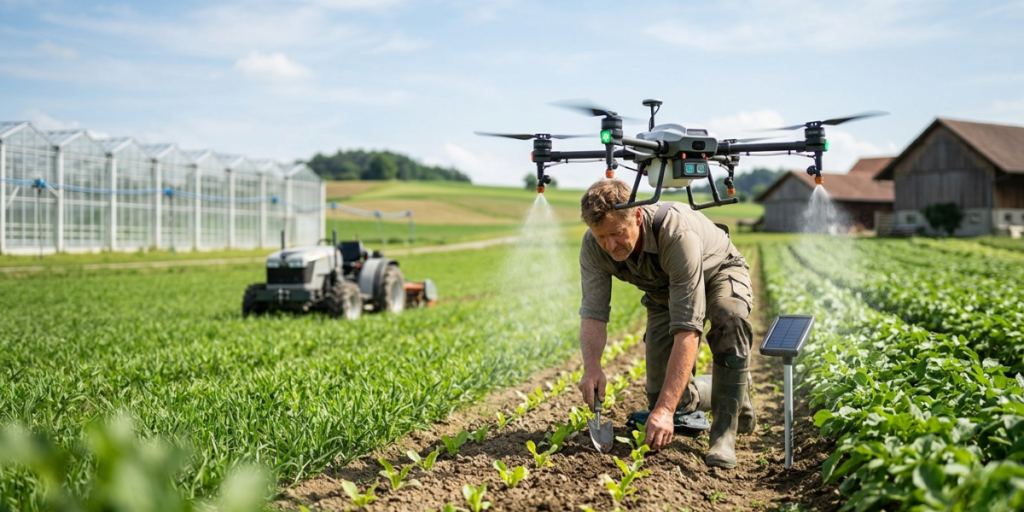
You’ve farmed the same fields for years, maybe generations. The instincts are real, the experience hard-won. So the question isn’t whether tradition works—it’s how to make it work even better with the right tools.
This guide shows you exactly how to integrate technology with traditional farming without throwing out what already works. You’ll learn which tools matter most, how to add them step by step, and where the real costs and trade-offs hide. By the end, you’ll have a clear, realistic plan for blending proven methods with modern efficiency.
Key Takeaways
- Technology enhances tradition—it doesn’t replace it. Your knowledge guides where tools add value.
- Start small with high-impact tools like auto-steer guidance before scaling up.
- Precision agriculture and in-ground sensors cut waste by applying inputs only where needed.
- Farm data management turns field information into smarter, cheaper decisions.
- Real challenges remain—upfront costs, data ownership, and a learning curve all matter.
Farming faces real pressure: rising input costs, labor shortages, and unpredictable weather. Traditional methods alone increasingly struggle against these forces. Technology helps close the gap.
The goal isn’t to abandon traditional farming methods. It’s to layer modern tools on top of proven practices so you work smarter, not harder. Think of it as keeping your judgment while gaining sharper eyes and steadier hands.
According to the USDA Economic Research Service’s report on precision agriculture adoption, tools like yield maps, soil maps, and variable rate technology have been used on corn and soybean acreage for years—while automated guidance now covers well over 50% of acreage for major row crops. Adoption is real and growing.
Mini takeaway: Technology supports your experience; it doesn’t compete with it.
Before you buy anything, it helps to know what each tool actually does. Here’s a plain-language look at the technologies driving smart farming today.
Auto-steer guidance uses GPS to steer equipment along precise paths. It reduces overlap, skips, and driver fatigue. For many farms, it’s the easiest first step—and it pays off fast.
The U.S. GAO notes that farmers use auto-steering equipment to plant fields with far greater accuracy, saving both inputs and time.
Variable rate technology (VRT) applies seed, fertilizer, or chemicals at different rates across a field. Instead of treating every acre the same, you put inputs only where they’re needed.
The result: less waste, lower costs, and reduced environmental runoff.
In-ground sensors give you near-real-time data on soil moisture, temperature, and nutrients. Rather than guessing when to irrigate or fertilize, you act on actual readings from below the surface.
Modern irrigation technology ties into sensor data to water crops precisely. This conserves water, protects soil, and cuts pumping costs—especially valuable in regions facing water scarcity.
Finally, farm data management ties it all together. Cloud platforms collect data from your machines and fields, then help you organize and analyze it. Tools like the John Deere precision ag technology platform connect machines, people, and data so you can monitor operations from anywhere.
Mini takeaway: Each tool solves a specific problem—learn what it does before deciding if you need it.
Different tools fit different farms, budgets, and goals. Use this table to see where each one fits.
Technology | Primary Benefit | Best Starting Point For | Key Consideration |
|---|---|---|---|
Auto-Steer Guidance | Reduces overlap and fatigue | Almost any row-crop farm | Needs a GPS receiver and display |
Variable Rate Technology | Cuts input waste | Farms with variable soil | Requires soil/yield maps |
In-Ground Sensors | Real-time soil insight | Irrigation-heavy operations | Needs connectivity in the field |
Irrigation Technology | Saves water and energy | Water-scarce regions | Higher setup complexity |
Farm Data Management | Smarter decisions | Any data-collecting farm | Requires learning the software |
The pattern is clear: start with the tool that solves your biggest pain point, then expand.
Mini takeaway: Match the technology to your farm’s specific challenge, not to the hype.
Ready to act? Follow this practical sequence to add technology without overwhelming your operation or budget.
Start with a question: where do you lose the most money, time, or yield? Maybe it’s wasted fertilizer, overlapping passes, or guesswork irrigation. Pinpoint one clear pain point first.
Before applying variable inputs, you need to know your land. Gather yield maps and soil maps to understand where your fields differ. This data is the foundation for digital agriculture decisions.
Don’t buy everything at once. Pick a single tool—often auto-steer guidance—that delivers quick, measurable returns. Learn it well before adding more.
Set up a farm management platform to collect data from your equipment. Even a free cloud account gives you a single place to monitor, organize, and review what’s happening across your operation.
Once you have maps and data, layer in variable rate technology and sensors. Now you’re applying precision agriculture principles—putting the right input in the right place at the right time.
Each season, compare results against your data. Did inputs drop? Did yields hold or rise? Use those answers to refine your approach and decide what to add next.
Reader checkpoint: If you’ve identified one clear problem and one tool to address it, you’re ready to start.
So what do you actually gain? When done thoughtfully, integrating technology delivers concrete results.
The GAO’s technology assessment confirms these advantages, noting precision agriculture can make farms more profitable while reducing fertilizer runoff into waterways. These benefits support sustainable agriculture goals alongside your bottom line.
Picture a corn farmer using soil maps and VRT. Instead of blanket-spreading fertilizer, they apply more to poor zones and less to rich ones. Costs drop, yields stay strong, and runoff falls—all from one data-driven change.
Mini takeaway: The payoff compounds—savings in one area free up resources for the next improvement.
Honest guidance means naming the hurdles. Technology helps, but it isn’t friction-free.
The latest tools carry real price tags. The GAO identifies high acquisition costs as a major barrier, especially for farmers with limited capital. Starting small helps spread that investment over time.
Who owns your farm data? Concerns about data sharing, privacy, and competitive advantage are common. Read license agreements carefully and favor platforms with transparent, simple terms.
Different brands don’t always work together. The GAO points to a lack of uniform standards that can hamper interoperability between systems. Check compatibility before you buy.
New tools take time to master. Budget for training and lean on resources like USDA Extension services and dealer support. Global knowledge networks such as the FAO’s e-Agriculture community of practice also share practical guidance on using digital tools in farming.
Mini takeaway: Plan for cost, compatibility, and learning time—these decide whether adoption succeeds.
First-timers often stumble in predictable ways. Sidestep these to protect your investment:
Avoid these and you’ll adopt technology like a seasoned operator from the start.
Still unsure where to begin? Use these simple principles to guide your decision:
Mini takeaway: The best starting point is the one that solves a real problem you already understand.
Auto-steer guidance is often the easiest and most rewarding starting point. It uses GPS to reduce overlap and driver fatigue, delivering quick, measurable savings on fuel, inputs, and time. Because it requires only a display and receiver to begin, many farms find it the simplest entry into precision agriculture before scaling up to sensors or variable rate tools.
Not necessarily. Many precision tools can be added to equipment you already own through upgrade kits and add-on displays or receivers. This lets you adopt smart farming gradually without buying entirely new machinery. Starting with upgrades spreads out costs and reduces risk while you learn how the technology fits your operation.
For many farms, yes—but it depends on scale and goals. Precision agriculture can lower input costs, boost yields, and reduce environmental impact, which improves profitability over time. However, upfront costs are real, so start with one high-impact tool, measure the results, and reinvest savings. This phased approach keeps risk low while building proof of value.
Technology supports sustainability by applying inputs precisely. Variable rate technology and in-ground sensors reduce excess fertilizer, chemicals, and water, which lowers runoff into soil and waterways. Efficient irrigation conserves water in scarce regions. Together, these practices protect natural resources while maintaining or improving yields—aligning environmental goals with farm profitability.
Integrating technology with traditional farming isn’t about replacing your hard-earned knowledge—it’s about amplifying it. With tools like auto-steer guidance, variable rate technology, in-ground sensors, and farm data management, you can cut waste, boost efficiency, and farm more sustainably while staying true to proven methods.
Your next step is simple. Pick the one problem that costs you most this season, then choose a single tool to address it. Map your fields, connect your data, and measure the results before expanding. Tradition gave you the foundation—technology helps you build on it, one smart, deliberate step at a time.
Powered by Digital AI Tips – All rights reserved.