
Discover everything you need to know about the Anthropic AI Fellowship 2026, including eligibility, application steps, key benefits, and how the program is shaping the future of AI safety and research.
Artificial intelligence is evolving at a breakneck pace, and with it comes the urgent need for responsible, safe, and aligned research. As we navigate the complex landscape of generative AI and large language models (LLMs), top-tier research organizations are stepping up to cultivate the next generation of AI leaders. Enter the Anthropic AI Fellowship 2026.
If you are a researcher, engineer, or policy expert looking to make a meaningful impact on the trajectory of machine learning, this program is designed for you. The 2026 Fellowship focuses on bridging the gap between cutting-edge AI capabilities and rigorous safety standards, rooted in the principles of Constitutional AI.
In this comprehensive guide, we will break down exactly what the Anthropic AI Fellowship entails, why it holds massive significance in the global tech community, and how you can position yourself as a prime candidate.
Here is what we will cover:
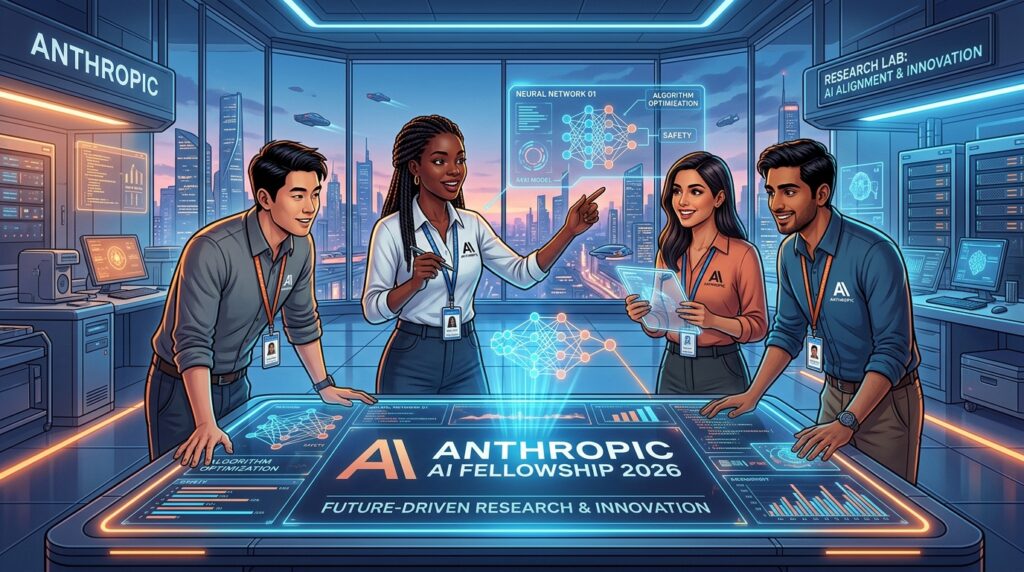
The Anthropic AI Fellowship is a prestigious, highly competitive program designed to support exceptional individuals dedicated to advancing AI safety, alignment, and interpretability. Launched by Anthropic, the research company behind the Claude family of models, the fellowship aims to fund and mentor independent researchers who want to tackle the most pressing challenges in artificial intelligence.
In 2026, the fellowship places a renewed emphasis on scalable oversight, mechanistic interpretability, and robust policy frameworks. As models become increasingly autonomous and capable, the fellowship provides a structured environment where brilliant minds can explore how to keep these systems helpful, honest, and harmless.
Unlike traditional academic grants, the Anthropic AI Fellowship is deeply integrated into a practical, fast-paced industry environment. Fellows are not just writing theoretical papers; they are testing their hypotheses on state-of-the-art models and collaborating directly with the teams building the next iterations of Claude.
The AI industry is currently facing a critical bottleneck: the ratio of capability researchers to safety researchers is heavily skewed. While thousands of engineers are working on making models faster, cheaper, and more capable, significantly fewer are focused on ensuring these models behave safely at scale.
The Anthropic AI Fellowship 2026 is crucial for several reasons:
By offering substantial financial backing and computational resources, the fellowship incentivizes top talent to pivot toward AI alignment and safety. It signals to the broader tech community that responsible AI is not just an afterthought—it is a primary pillar of modern software development.
Understanding the “black box” of neural networks is one of the greatest scientific challenges of our time. The fellowship supports researchers trying to reverse-engineer how large language models represent concepts, helping the industry move from empirical guessing to rigorous mathematical understanding.
The fellowship is not strictly limited to coders. Policy researchers play a vital role in drafting frameworks that governments and international bodies can use to regulate AI. Insights generated by Anthropic Fellows frequently inform discussions at global AI safety summits, impacting worldwide technological governance.
The Anthropic AI Fellowship is known for its rigorous selection process. However, it is also highly interdisciplinary. You do not necessarily need a PhD in computer science to be considered, provided you can demonstrate exceptional critical thinking and technical competence in your domain.
Anthropic looks for individuals who are intellectually humble but highly ambitious. If you are someone who questions consensus, rigorously stress-tests your own hypotheses, and cares deeply about the long-term impacts of artificial intelligence on humanity, you fit the ideal profile.
Securing a spot in the 2026 cohort requires preparation, clarity of thought, and a compelling research proposal. The application process is generally structured into four distinct phases.
The first step involves submitting your resume, a portfolio of relevant work (such as a GitHub profile or Google Scholar link), and a statement of interest. In your statement, clearly articulate why you want to work on AI safety and how Anthropic’s unique environment will help you achieve your goals.
If you pass the initial screening, you will be asked to submit a detailed research proposal (typically 2-3 pages). This is the most critical part of the application.
For engineering and empirical research tracks, expect a rigorous technical assessment. You may be asked to review a piece of PyTorch code, propose a solution for an alignment failure in a hypothetical model, or write a script to extract specific activations from a small transformer.
The final stage consists of interviews with senior Anthropic researchers and past fellows. These discussions will dive deep into your research proposal. Expect them to challenge your assumptions. They want to see how you respond to feedback and whether you can iterate on your ideas collaboratively.
Being selected as an Anthropic AI Fellow is a career-defining opportunity. The program provides a comprehensive support system designed to remove all friction from the research process.
Fellows receive a highly competitive stipend that matches top-tier industry salaries. This ensures that financial constraints do not deter brilliant minds from pursuing safety research over lucrative corporate engineering roles.
AI research requires massive computational power. One of the biggest barriers for independent researchers is the cost of GPUs. Fellows are granted extensive compute budgets, allowing them to train custom models, run large-scale evaluations, and experiment without worrying about cloud billing limits.
You will be paired with senior researchers at Anthropic who act as advisors. These mentors provide guidance on experimental design, help you navigate roadblocks, and offer invaluable feedback on your findings before publication.
By joining the fellowship, you become part of a tight-knit community of the world’s leading AI thinkers. You will have opportunities to collaborate with organizations like the Alignment Research Center and other key players in the ecosystem. This network will pay dividends long after the fellowship ends.
Many brilliant applicants fail to make the cut due to easily avoidable errors. Here are the most common pitfalls and how to ensure your application stands out:
The Anthropic AI Fellowship 2026 is more than just a grant program; it is a catalyst for industry-wide change. The research produced by fellows consistently pushes the boundaries of what we understand about artificial neural networks.
While the models themselves may be proprietary, the safety techniques and alignment breakthroughs discovered during the fellowship are frequently published as open-access papers. This contributes to a global repository of knowledge, allowing smaller startups and academic institutions to implement better safety guardrails in their own projects.
The empirical findings from fellowship research directly influence the development of future iterations of Claude and other foundational models. Whether it is a new technique for red-teaming or a novel approach to mitigating bias, the work done here has immediate, real-world applications.
As fellows graduate from the program, they carry the principles of rigorous, safety-conscious AI development into their subsequent roles at other tech giants, startups, and government advisory boards. This creates a ripple effect, gradually standardizing ethical AI development practices across the entire global economy.
The Anthropic AI Fellowship 2026 represents a unique intersection of academic rigor, industry resources, and a deep commitment to the safe development of artificial general intelligence. It is a rare opportunity to tackle the most important technological challenges of our era alongside some of the brightest minds in the world.
If you are passionate about AI alignment, interpretability, or policy, this is your chance to make a tangible impact.
Next Steps:
By taking these steps today, you will be well-prepared to submit a standout application for the Anthropic AI Fellowship 2026. The future of AI needs responsible leaders—make sure you are one of them.