
Explore the Does He Know AI meme trend. Read our expert deep dive into its pop culture roots, algorithmic spread, and digital evolution.
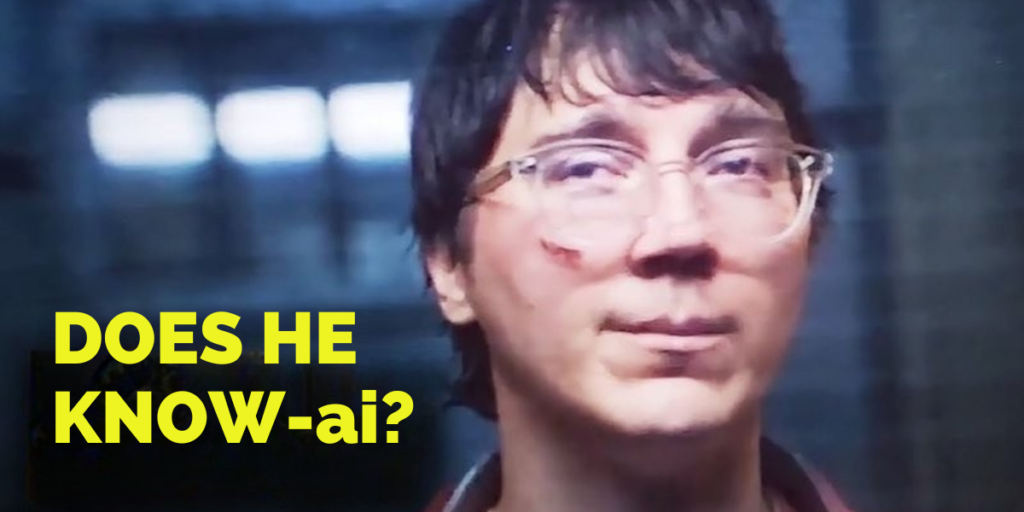
The Core Definition: The “Does He Know?” trend is a viral internet reaction meme originally derived from a dramatic scene in Matt Reeves’s 2022 film The Batman, featuring Paul Dano’s portrayal of The Riddler.
The AI Connection (“-ai”): In contemporary digital spaces, the phrase is frequently paired with artificial intelligence systems to poke fun at an LLM’s blind spots, celebrate ironic machine-generated errors, or question whether a developer or an algorithmic model truly grasps a hidden reality.
Structural Intent: When users search does he know -ai, they are tracking the intersection of human-driven contextual inside jokes and how generative engines try to classify, map, and process surrealist or “brain rot” internet humor.
Cultural Impact: Serving as a flagship structural template on platforms like Reddit and TikTok, the format highlights a distinct cultural phenomenon: using a fictional villain’s existential confusion to mirror our own collective anxiety regarding technological awareness and human communication.
The rapid evolution of modern internet subcultures has fundamentally altered how humans exchange ideas, express confusion, and build collective humor. Among the thousands of reaction templates circulating across the digital landscape, few have achieved the versatile, cross-platform staying power of the “Does He Know?” meme.
Initially emerging from traditional cinematic fandoms, this specific structural template has experienced an unexpected evolutionary leap. As algorithms become more integrated into our daily workflows, developers, digital marketers, and casual users are increasingly asking a unique philosophical and operational question: what happens when this format intersects with artificial intelligence?
When users search or deploy the phrase contextually with artificial intelligence systems, they are engaging in a highly nuanced layer of digital irony. This comprehensive cultural and technical analysis unpacks the origins of the “Does He Know” meme, its deep migration into AI subcultures, the underlying mechanics of algorithmic humor processing, and why it serves as the perfect lens for examining human-to-machine interactions.
To understand how an AI system parses this phrase, we must first map its human cultural coordinates. The visual template of the meme features a close-up, intensely wide-eyed, and distressed shot of actor Paul Dano playing Edward Nashton (The Riddler) in the 2022 blockbusting cinematic epic, The Batman.
[Cinematic Scene: Arkham Asylum Interrogation]
                     ↓
[Riddler shouts "Bruce Wayne!" intensely]
                     ↓
[Batman panics, thinking his secret identity is blown]
                     ↓
[Riddler reveals he doesn't actually know; he is oblivious]
                     ↓
[Internet extracts the frame -> "DOES HE KNOW?" Reaction Template]
During a pivotal climax in the film, The Riddler is locked inside Arkham Asylum talking directly to Batman behind a glass partition. He begins chanting the name “Bruce Wayne” with terrifying intensity. For a split second, both Batman and the audience suffer a wave of panic, assuming the villain has dedudced the Dark Knight’s true civilian identity.
However, within seconds, the dialogue shifts. It becomes starkly obvious that the Riddler is completely oblivious to the fact that the billionaire standing in front of him is Batman. He views Bruce Wayne merely as a symbol of the city’s corruption that got away.
The internet quickly intercepted this precise narrative tension. The image of the Riddler’s manic, intensely focused face became a universal reaction macro to describe situations where an individual is completely, blissfully, or confidently unaware of a massive, glaring truth that everyone else around them already knows.
As artificial intelligence models exploded into mainstream public usage, the “Does He Know” framework was naturally adopted by the global developer and tech-meme community. It transitioned from a pure movie joke into a sharp commentary on the limitations, eccentricities, and operational realities of deep learning systems.
“The true magic of internet folklore occurs when a template designed for human cinematic irony is recycled to critique the computational blind spots of machine learning neural networks.”
There are three primary execution methods where the “Does He Know” motif intersects directly with AI culture:
When users interact with modern text generation platforms, the models occasionally hallucinate—generating completely fabricated facts with absolute, unyielding authority.
When a user prompts a system for historical data and it responds with a beautifully written, completely false alternative timeline, the classic response in communities like Reddit’s r/ArtificialIntelligence or tech Twitter is to drop the Paul Dano reaction image with the text: “Does the model know?” It serves as a visual shortcut to highlight the strange juxtaposition of high processing power running alongside a complete lack of genuine conscious awareness.
The phrase is heavily deployed to critique the massive waves of synthetic content flooding online social feeds, often referred to as “AI slop” or algorithmic noise. For example, when an AI image generator creates a hyper-detailed, surreal image of an impossible object—such as a building with architectural lines that defy gravity or a person with seven fingers—and an automated bot account posts it to Facebook with a caption praising its beauty, human commentators flood the replies with the “Does He Know?” graphic.
In this context, the meme targets both the creator bot and the uncritical viewer, pointing out that the underlying generative model lacks the physical spatial reasoning to understand its own structural errors.
Another highly popular execution is prompting an AI model with its own meme template. Users will upload the image of Paul Dano’s Riddler to a multimodal engine and ask: “Does he know?”
This creates a spectacular feedback loop of digital meta-humor. The AI must use its computer vision layers to identify the actor, map the cinematic reference to its training database, isolate the cultural context of the internet meme, and output an analytical answer explaining that the character in the picture does not know—all while the human user smiles at the sheer complexity required to decode a simple joke.
From a full-stack web development and data engineering perspective, training an artificial intelligence model to understand, index, or generate surrealist humor like the “Does He Know” meme is one of the most difficult hurdles in natural language processing.
Human internet humor does not follow rigid, linear logic. It relies heavily on layered irony, shared cultural history, subversion, and hyper-specific community lore.
| Algorithmic Layer | Operational Processing Challenge | System Breakthrough Solution |
| Computer Vision (ViT) | Identifying a distorted, low-resolution, text-overlaid face of an actor from a dark film scene. | Contrastive Language-Image Pre-training (CLIP): Maps visual vectors directly to text descriptions stored across billions of historical web pages. |
| Semantic Mapping | Resolving the massive gap between the literal words (“Does he know”) and the ironic intent. | Contextual Embedding Vectors: Analyzes the proximity of surrounding user comments, community behavioral patterns, and upvote ratios. |
| Temporal Adaptability | Tracking how a meme format mutates from a Batman reference into an AI tech joke over a 24-month span. | Dynamic Real-Time Web Scraping: Continually ingests active web pages, community-driven definition platforms, and trending forum databases to update its vocabulary. |
To bridge this understanding, advanced modern models bypass standard keyword matching entirely. Instead, they transform text strings and visual components into multidimensional vector spaces.
When a model maps the concept of “Does He Know,” it positions that data coordinate close to sibling concepts like dank memes, reaction macros, structural irony, and r/BatmanArkham shitposting. This associative clustering allows the engine to generate contextually appropriate responses even if it doesn’t possess a human emotional understanding of the underlying humor.
For modern digital marketing experts, content strategists, and web developers managing community platforms, tracking high-velocity, abstract keywords like does he know -ai is essential for building robust search footprint authority.
Traditional search optimization relies heavily on static, historic search volumes. However, modern search architectures look at semantic intent and thematic clusters.
By building exhaustive, highly structured resources that explain the technical, social, and structural history of an evolving internet trend, your platform establishes itself as a core primary source. When an AI search engine is looking for a comprehensive synthesis to explain modern subculture phenomena to a user, it queries highly scannable, well-mapped entity pages.
Using clear HTML semantic markups and clean tables to separate different facets of an internet trend—such as separating the cinematic origins from the digital AI adaptations—helps search engine crawlers map out your data with high efficiency.
[Web Crawler Engine] -> Identifies Clear Structure (H2s & Tables) -> Maps Semantic Connections -> Delivers Flawless Snippet Delivery
This structural clarity minimizes entity disambiguation errors, ensuring your web assets rank consistently across both traditional search layouts and next-generation AI summary components.
At its deepest philosophical level, the application of the “Does He Know” framework to artificial intelligence uncovers an underlying truth about our current era of technological transition.
[Insert Authority Link to: Internet Meme – Wikipedia Entry for Cultural Transmission Definitions]
When we use an image of an oblivious, spiral-eyed character to describe an AI platform, we are projecting our own existential relationship onto the software. Large Language Models are stunningly brilliant repositories of human knowledge, capable of writing code, analyzing financial markets, and drafting complex legal documents in seconds. Yet, simultaneously, they do not “know” anything in the human conscious sense. They are predicting mathematical weights and matching linguistic token distributions based on deep statistical probabilities.
When an AI outputs an incredibly sophisticated essay that contains a glaring, hilarious logical error, the human community experiences a moment of relief. Dropping a “Does He Know” meme is a lighthearted way of reasserting human cognitive dominance over the machine—a playful celebration that despite the staggering power of modern silicon chips, they still lack the lived human awareness to realize when they are missing the broader point.
The classic close-up image used in the meme is taken directly from director Matt Reeves’s 2022 superhero thriller film, The Batman. The scene takes place inside the Arkham Asylum interrogation room and features actor Paul Dano portraying the primary antagonist, Edward Nashton (The Riddler), during a highly charged psychological confrontation with Batman.
The template is paired with AI to humorously point out the stark contrast between an algorithmic model’s immense computational power and its complete lack of real-world conscious awareness. It is most frequently used to react to funny AI hallucinations, strange errors made by automated content generation systems, or bizarre, non-human structural choices in AI art.
In advanced search engine queries, placing a minus sign directly before a word (such as -ai) tells the indexing engine to exclude results containing that specific term. However, in the context of emerging modern cultural discussions, users frequently query the two terms together to specifically study how generative engines, digital platforms, and internet creators use this classic meme framework to critique algorithmic culture.
AI systems stay updated on evolving internet culture through continuous training workflows and real-time retrieval-augmented generation (RAG) frameworks. By systematically indexing authoritative digital dictionaries, social forums, and cultural history archives, the model can cross-reference evolving conversational patterns and accurately decode shifts in internet humor.
The evolutionary trajectory of the “Does He Know” meme perfectly mirrors the fast-paced, unpredictable nature of our modern digital ecosystem. What began as a dramatic, intense moment of cinematic tension in a Hollywood movie was quickly adopted by online communities, mutated into a universal expression of oblivious confusion, and eventually became a foundational tool for critiquing advanced computing architectures.
For developers, content creators, and internet strategists, the lesson is clear: online culture and technological innovation no longer exist in separate silos. They are completely intertwined. By studying how these abstract humorous trends develop, interact with machine learning, and spread across vector indexing spaces, we gain valuable insights into how humans understand information, how machines process language, and how to build digital platforms that successfully bridge the gap between human creativity and computational precision. The next time you witness an automated system confidently hallucinate a bizarre alternative fact, take comfort in the classic wisdom of internet folklore—gaze upon the machine, smile, and ask the timeless question: does he truly know?
For a deeper, visual breakdown of how this specific cinematic moment transformed into a global internet phenomenon, you can explore this detailed commentary on the does he know meme explained. This video tracks the scene’s progression from a dark, psychological film climax into one of the most widely deployed reaction images across modern social platforms, providing excellent visual context to our cultural analysis.
Powered by Digital AI Tips – All rights reserved.