
Dive into the latest NVIDIA earnings report. We break down key financial metrics, AI growth drivers, market challenges, and what it means for the tech industry.
NVIDIA recently released its latest quarterly earnings report, and the numbers have sent massive ripples across the global financial markets. As the undisputed leader in artificial intelligence hardware, NVIDIA serves as the bellwether for the entire tech sector. When this semiconductor giant speaks, investors, competitors, and tech enthusiasts listen closely.
You might want to understand exactly what these numbers mean for the future of technology and your own investment portfolio. Reading raw financial statements can feel overwhelming. We will break down the complex data into clear, actionable insights.
By the end of this guide, you will understand the core financial metrics driving NVIDIA’s valuation. You will learn about the primary growth drivers pushing the company forward, the challenges that could slow its momentum, and how its performance dictates the direction of the broader AI industry.
Here is what we will cover:
To understand the sheer scale of NVIDIA’s success, we must look at the hard numbers. The latest NVIDIA earnings report delivered historic figures, consistently beating Wall Street estimates on both the top and bottom lines.
NVIDIA’s total revenue reached astronomical levels this quarter. The company reported year-over-year revenue growth that surpassed 200%. This type of explosive growth is incredibly rare for a company of this massive size. Most mega-cap technology companies celebrate a 15% revenue increase. NVIDIA is operating on an entirely different playing field.
The primary catalyst for this revenue surge is the global artificial intelligence boom. Companies around the world are rushing to build generative AI models, and they need NVIDIA’s highly specialized graphics processing units (GPUs) to do it.
The Data Center segment is the true engine of NVIDIA’s current business model. Historically, NVIDIA made most of its money selling graphics cards to video game players. Today, the Data Center segment accounts for the vast majority of total revenue.
This segment includes the sales of the highly coveted H100 Tensor Core GPUs. These chips act as the brains behind massive AI systems like ChatGPT. As hyperscale cloud providers—such as Amazon Web Services, Microsoft Azure, and Google Cloud—build out their AI infrastructure, they buy these chips by the tens of thousands. The Data Center revenue alone outpaces the entire total revenue of many of NVIDIA’s direct competitors.
Revenue only tells half the story. You must also look at how efficiently a company turns that revenue into profit. NVIDIA reported gross margins hovering around the 75% mark.
This metric is staggering for a hardware manufacturer. Building physical computer chips requires expensive materials, complex manufacturing facilities, and massive supply chain logistics. Typically, hardware companies operate on thin margins. Because NVIDIA’s chips are so advanced and in such high demand, the company commands incredible pricing power. They set the price, and buyers eagerly pay it, leading to massive operating income and robust cash flow.
You can review the raw financial statements and historical data directly on NVIDIA Investor Relations to see these margins in detail.

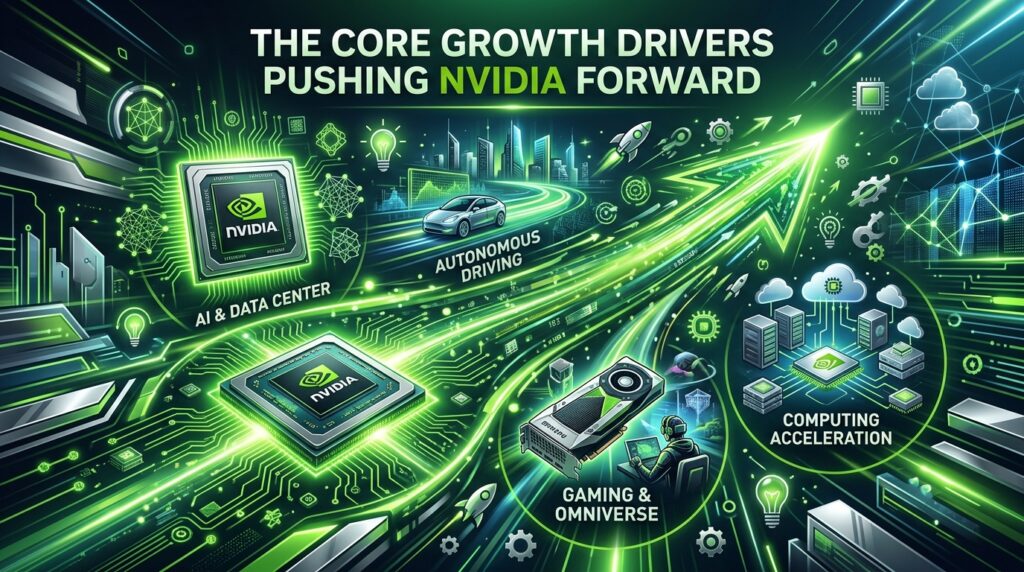
NVIDIA did not reach a multi-trillion-dollar valuation by accident. The company spent over a decade investing heavily in software and hardware architectures that anticipated the AI revolution. Three primary growth drivers ensure the company maintains its massive lead.
Artificial intelligence requires massive computational power. Training a large language model involves processing petabytes of data through billions of parameters. Traditional computer processors (CPUs) cannot handle this workload efficiently.
NVIDIA GPUs process multiple calculations simultaneously. This parallel processing capability makes them the only viable option for serious AI training. The demand for these chips massively outstrips the available supply. Companies wait months to receive their orders. This supply-demand imbalance guarantees strong revenue streams for NVIDIA for the foreseeable future, as every major enterprise scrambles to secure computing power.
Technology moves incredibly fast. NVIDIA knows that resting on its current success will invite competition. The company recently announced its next-generation architecture, known as Blackwell.
The Blackwell platform promises to be significantly faster and more energy-efficient than the current Hopper architecture. This transition is crucial for two reasons. First, it forces current customers to eventually upgrade their hardware to stay competitive. Second, improved energy efficiency helps data centers manage their massive electricity costs. As long as NVIDIA continues to release generational leaps in performance, they will force the rest of the industry to play catch-up.
We are witnessing a new trend called “Sovereign AI.” Entire countries are realizing that artificial intelligence is a matter of national security and economic independence. Governments in Europe, the Middle East, and Asia are building their own localized AI models trained on their native languages and cultural data.
To build these sovereign models, governments are buying massive clusters of NVIDIA GPUs. This creates an entirely new customer base that operates on government budgets. Sovereign AI represents a multi-billion-dollar growth vector that extends far beyond the traditional corporate tech sector.
When NVIDIA releases an earnings report, it acts as a health check for the entire technology ecosystem. The company sits at the very center of the global supply chain, and its financial results send clear signals to other markets.
NVIDIA’s dominant earnings reports put immense pressure on its competitors, specifically AMD and Intel. These companies are desperately trying to grab a share of the AI hardware market.
When NVIDIA reports strong sales and high margins, it proves the market is expanding. It also sets a very high bar for performance. Competitors must spend heavily on research and development to offer a viable alternative. If AMD or Intel can produce a chip that offers 80% of NVIDIA’s performance at half the price, they might capture the lower end of the market. However, NVIDIA’s current software ecosystem, known as CUDA, makes it very difficult for developers to switch to competing hardware.
The biggest tech companies in the world are also NVIDIA’s biggest customers. Microsoft, Google, and Amazon spend billions of dollars every quarter on AI infrastructure.
NVIDIA’s earnings call provides a direct look into the capital expenditure plans of these tech giants. If NVIDIA reports a massive increase in forward guidance, it means the cloud providers are still buying hardware aggressively. This signals to investors that the major tech platforms believe the AI boom is just beginning. It reassures the market that these companies see a clear path to turning their expensive AI infrastructure into profitable software services.
A strong NVIDIA earnings report also acts as green light for venture capitalists. When the hardware layer of the AI industry shows extreme health, investors feel confident pouring money into the software layer.
Thousands of AI startups rely on this computing power to build specialized applications for healthcare, finance, and logistics. NVIDIA’s continued success ensures that the foundational infrastructure remains stable and improving, giving software developers the tools they need to innovate. You can read more about how startups utilize these tools on technology news platforms like TechCrunch.
Despite the historic numbers, NVIDIA’s path forward is not entirely clear. The company faces significant risks that could derail its momentum or compress its profit margins over the next few years.
NVIDIA designs its chips, but it does not physically build them. The company relies heavily on Taiwan Semiconductor Manufacturing Company (TSMC) to fabricate the silicon.
TSMC currently operates at maximum capacity. Building new semiconductor fabrication plants takes years and costs tens of billions of dollars. If a geopolitical event disrupts the supply chain in Taiwan, or if natural disasters hit key manufacturing hubs, NVIDIA will not be able to produce enough chips to meet demand. This severe bottleneck poses the greatest immediate risk to the company’s revenue targets.
The United States government views advanced artificial intelligence as a critical national security asset. To maintain a technological advantage over global adversaries, the US Department of Commerce placed strict export controls on high-end semiconductors.
NVIDIA is legally restricted from selling its most powerful chips to companies located in China and several other nations. China historically represented a massive portion of NVIDIA’s revenue. While the company developed slightly weaker chips specifically for the Chinese market to comply with regulations, these export controls limit global market penetration. Any further tightening of international trade rules could severely damage NVIDIA’s international revenue streams.
The tech giants buying NVIDIA’s chips do not want to rely on a single supplier forever. Paying NVIDIA’s high profit margins eats directly into their own profitability.
To counter this, companies like Amazon, Google, and Microsoft are developing their own custom AI chips. Google uses its Tensor Processing Units (TPUs), while Amazon deploys its Trainium and Inferentia chips. Right now, these custom chips cannot fully replace NVIDIA’s top-tier GPUs. However, as these companies refine their hardware over the next five years, they could shift a significant portion of their workloads away from NVIDIA, threatening the company’s monopoly on data center computing.
Perhaps the biggest immediate challenge NVIDIA faces is its own success. The stock market prices companies based on future expectations. NVIDIA’s stock price reflects an expectation of flawless execution and continued exponential growth.
If the company misses an earnings estimate by even a small margin, or if forward guidance indicates that growth is slowing down, the market reaction could be swift and severe. Maintaining a growth rate of 200% is mathematically impossible over a long period. At some point, the growth will decelerate, and the company will have to manage extreme investor expectations carefully.
If you are following NVIDIA’s trajectory, you need to look past the headline numbers. Keep your eye on a few specific indicators as we move into the next fiscal year.
First, watch the timeline for the Blackwell architecture rollout. Any delays in manufacturing or shipping the next generation of chips could cause short-term turbulence. The market expects flawless execution, and supply chain hiccups will cause concern.
Second, monitor the capital expenditure plans of the big cloud providers during their own earnings calls. As long as Microsoft, Amazon, and Google commit to expanding their AI data centers, NVIDIA has a guaranteed pipeline of massive orders. If those companies announce a reduction in infrastructure spending, it serves as a massive warning sign for NVIDIA’s future revenue.
Third, pay close attention to the development of custom silicon. Track how many workloads companies shift to their proprietary chips. While NVIDIA will likely maintain the high-end training market, losing the less intensive inference market to custom chips could slowly erode their dominant market share.
The latest NVIDIA earnings report solidifies the company’s position as the most important player in the artificial intelligence revolution. Their staggering revenue growth, massive profit margins, and dominance in the data center market prove that the AI boom is a tangible economic shift, not just empty hype.
However, this unprecedented success brings immense challenges. NVIDIA must navigate complex supply chains, strict government regulations, and wealthy customers who are desperate to build their own competing hardware.
Your next step is to monitor how the broader technology industry responds. Watch how software companies utilize this massive influx of computing power to create profitable products. Keep an eye on global trade policies and competitor announcements. Understanding the forces driving NVIDIA will give you a clear advantage as you navigate the rapidly changing landscape of the modern tech economy.