
A clear, practical guide to how future healthcare technology is transforming at-home care. Explore remote patient monitoring, telehealth systems, AI, wearables, and hospital-at-home models—plus the real opportunities and limitations families should understand.
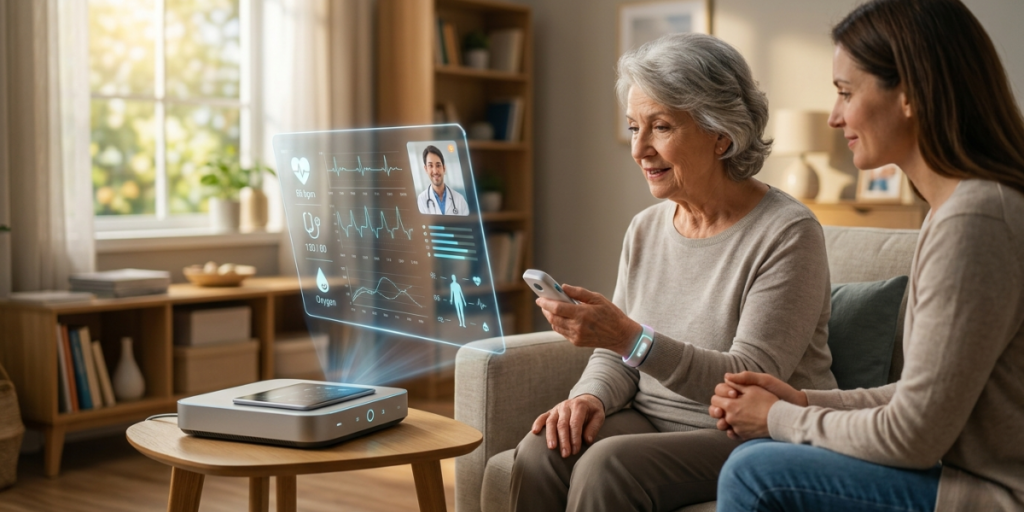
Imagine recovering from surgery in your own bed, with doctors tracking your vitals in real time from across the city. That scenario isn’t science fiction—it’s already happening. Future healthcare technology is steadily moving serious care out of hospitals and into living rooms.
This guide explains how that shift works, which tools are driving it, and what it means for patients and families. You’ll learn how remote monitoring, telehealth, AI, and wearables connect, where they shine, and where they still fall short. By the end, you’ll understand how to think clearly about technology-enabled care at home.
Key Takeaways
- At-home care technology lets patients receive monitoring and treatment without constant hospital visits.
- Remote patient monitoring and wearables track vital signs continuously and flag problems early.
- Telehealth systems and virtual care platforms connect patients to providers in real time.
- Hospital-at-home models deliver acute-level care in the home, often reducing hospital days.
- Limitations remain—reimbursement rules, data security, and the need for in-person exams still matter.
Healthcare is under pressure. Aging populations, rising chronic disease, and crowded hospitals all push the system toward a simple idea: care that comes to you.
The World Health Organization’s digital health work frames this clearly. Its global strategy positions digital tools as a way to make health systems more efficient, sustainable, and equitable—delivering quality care closer to where people actually live.
For patients, the appeal is obvious. Less travel, more comfort, and care that fits around real life. For health systems, it means fewer readmissions and better use of limited beds.
Why it matters: Moving care home isn’t just convenient—it addresses a structural strain that traditional hospitals can’t solve alone.
Several technologies work together to make modern home care possible. Understanding each one helps you see how the pieces fit.
Remote patient monitoring (RPM) is the backbone of at-home care. It collects physiological data—blood pressure, heart rate, glucose, oxygen levels—from a patient outside a clinic and sends it to care teams.
According to the StatPearls Telehealth Systems overview on NCBI Bookshelf, remote monitoring is one of the three core types of telemedicine, alongside synchronous (live) and asynchronous (store-and-forward) care. It enables continuous evaluation of a patient’s clinical status without a hospital stay.
The benefit is early warning. Instead of waiting for a scheduled visit, providers can spot a worrying trend and act before it becomes an emergency.
Wearable health devices—smartwatches, patches, and clip-on sensors—feed RPM systems with real-time data. They track everything from sleep and activity to irregular heart rhythms.
These devices turn passive patients into active participants. A wearable that flags an abnormal heart rhythm can prompt a timely check-in, sometimes catching issues the patient never noticed.
Telehealth systems connect patients and clinicians through video, phone, or messaging. Virtual care platforms bundle these tools with scheduling, records, and monitoring data in one place.
The StatPearls review notes telehealth is the fastest-growing sector of healthcare, with roughly 80% of patients viewing the experience favorably. It also helps close access gaps—especially in rural areas where about 20% of the U.S. population lives but only 9% of physicians practice.
AI in home care adds a layer of intelligence on top of all this data. It can sort routine readings from urgent ones, predict deterioration, and reduce alert fatigue for clinicians.
The WHO has begun publishing guidance on responsible AI in health, emphasizing both its promise and its risks. Used well, AI helps care teams focus attention where it’s needed most.
Why it matters: No single tool runs home care. The power comes from monitoring, wearables, telehealth, and AI working as one connected system.
One of the most striking developments is the hospital-at-home model. Here, patients who would normally be admitted receive acute-level care in their own homes.
The StatPearls overview describes these programs as a way to “admit” patients to their homes, supported by remote monitoring and regular provider contact. Research it cites shows home telehealth monitoring can reduce hospital days, and off-hours telehealth in nursing homes cut hospitalizations by around 10%.
Policy is catching up too. The CMS ACCESS model—Advancing Chronic Care with Effective, Scalable Solutions—is part of a broader push to expand access to digital health technologies for chronic conditions while protecting patient safety.
Why it matters: Hospital-at-home shows that even serious care can move home safely when the right technology and oversight are in place.
Different technologies serve different needs. This table helps you see where each fits.
Technology | Primary Role | Best For | Key Limitation |
|---|---|---|---|
Remote Patient Monitoring | Continuous vitals tracking | Chronic disease, post-discharge | Needs reliable devices and connectivity |
Wearable Health Devices | Real-time personal data | Prevention, early detection | Accuracy and adherence vary |
Telehealth Systems | Live or async provider contact | Consultations, follow-ups | Can’t replace hands-on exams |
AI in Home Care | Data analysis and alerts | Risk prediction, triage | Requires oversight and quality data |
Hospital at Home | Acute care in the home | Eligible acute patients | Strict eligibility and coordination needs |
Use this as a mental map. Most strong programs combine several of these rather than relying on just one.
So what does this actually mean for everyday people? The advantages are concrete.
Consider someone managing heart failure. With a connected scale, a wearable, and a virtual care platform, their care team can spot fluid buildup early—often before symptoms turn serious. A quick medication adjustment over video may prevent a hospital admission entirely.
Why it matters: These benefits compound. Better monitoring leads to earlier action, which leads to fewer crises and lower costs.
Honest guidance means acknowledging the gaps. Technology-enabled home care is powerful, but it isn’t perfect.
Payment remains a major hurdle. The StatPearls review identifies reimbursement and parity laws as the largest barrier to telehealth adoption, with rules varying widely by state and program. Coverage that works in one place may not apply in another.
Telehealth can’t physically examine you. The same review notes that remote care has led to misdiagnoses in some cases, and that direct-to-consumer services can sometimes drive over-utilization rather than replace in-person visits. Hands-on assessment still matters for many conditions.
More connected devices mean more data—and more risk. Electronic information breaches can violate privacy laws like HIPAA. Strong security is essential, not optional.
Wearables and AI tools vary in quality. This is exactly why oversight bodies matter. The FDA Digital Health Center of Excellence works to advance responsible, high-quality digital health innovation while ensuring devices meet safety and effectiveness standards.
Why it matters: Smart adoption means weighing benefits against real constraints—not assuming technology alone solves everything.
If you or a loved one are considering these tools, a measured approach pays off. Keep these principles in mind:
Why it matters: The goal isn’t to use the most technology—it’s to use the right technology, safely and effectively.
The trajectory is clear. Lower-latency connections, smarter AI, and more capable devices will keep expanding what’s possible at home. The WHO continues to develop strategy through the latter part of this decade, and regulators like the FDA are piloting new approaches to chronic disease technologies.
Expect more integration: platforms that unify wearables, monitoring, AI insights, and virtual visits into one seamless experience. As reimbursement and standards mature, hospital-at-home and chronic care management will likely become routine rather than novel.
Why it matters: This isn’t a passing trend. It’s a structural shift in where and how care happens.
Remote patient monitoring collects health data—like blood pressure, heart rate, and glucose—from patients outside a clinical setting and sends it to their care team. At home, it enables continuous tracking so providers can spot worrying trends early and intervene before problems escalate. It’s especially valuable for chronic conditions and recovery after a hospital stay.
No. Telehealth systems are excellent for consultations, follow-ups, and monitoring, and most patients rate the experience favorably. However, they can’t physically examine you, and remote-only care has led to misdiagnoses in some cases. The best approach uses virtual care to complement in-person visits, not entirely replace them.
It can be, with the right safeguards. Approved devices that meet regulatory standards—overseen by bodies like the FDA—are generally reliable. The main risks involve data privacy, since connected devices generate sensitive information that must be protected under laws like HIPAA. Choosing secure, reputable platforms is essential.
Hospital at home is a model where patients who would normally be admitted to a hospital instead receive acute-level care in their own homes. Supported by remote monitoring, regular provider contact, and sometimes AI-driven alerts, these programs can reduce hospital days for eligible patients while keeping them in a more comfortable setting.
Future healthcare technology is reshaping where care happens—moving monitoring, consultations, and even acute treatment into the home. Remote patient monitoring, wearables, telehealth systems, AI, and hospital-at-home models together make this possible, offering earlier intervention, better chronic care, and real cost savings. Yet limitations around reimbursement, remote exams, data security, and device quality mean technology works best as a partner to skilled human care, not a replacement.
Your next step is simple: if at-home care could help you or a loved one, start a conversation with a trusted provider. Ask which monitoring tools and virtual platforms fit your needs, confirm coverage, and prioritize approved, secure technology. Done thoughtfully, technology-enabled home care can deliver safer, more comfortable, and more connected care than ever before.
Powered by Digital AI Tips – All rights reserved.